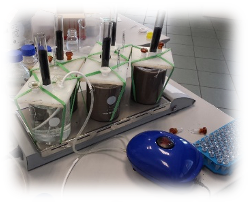

Nutrients
Experimental studies and mathematical modeling on:
- Traditional systems (i.e., CAS) and innovative systems (e.g., MBR and MBBR) for the biological removal of nitrogen from urban and industrial wastewater;
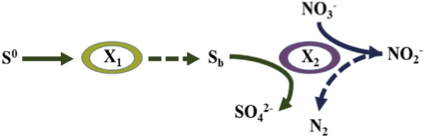
- Autotrophic denitrification;
- Coupling of the biogeochemical cycles of nitrogen and sulfur;
- Colonization of multispecies biofilms with heterotrophic, nitrifying, denitrifying, AnAmmOx, and sulfate-reducing microorganisms;
- Biological sulfate and selenate reduction;
- Microalgae-based systems for N and P removal.
Metalli
- Stimulation, inhibition, and toxicity of metal addition in biological systems;
- Use of Fe(II) for the stimulation of autotrophic denitrification and production/recovery of biominerals; Precipitation of metals with biogenic sulfide;
- Co-precipitation of arsenic on iron biominerals;
- Recovery of metals and rare earth elements from waste electrical and electronic equipment;
- Removal of heavy metals from soils using chelating agents through soil washing and soil flushing;
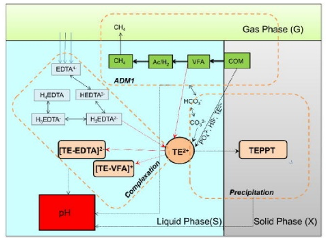
- Mathematical modelling of the mechanisms (e.g. precipitation, complexation) related to the addition of trace metals in anaerobic digestion.
Disinfezione e acque potabili
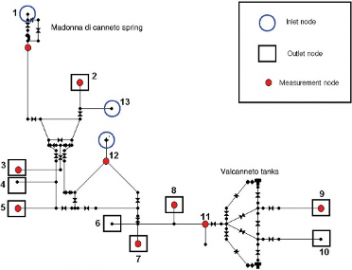
- Control of disinfection by‑products in water distribution systems;
- Modeling of trihalomethane (THM) formation in water distribution networks; Evaluation of optimal chlorine dosing;
- Modeling of water quality decay in distribution networks.
Processi di ossidazione avanzata
- Removal of pharmaceutical compounds from wastewater using electrochemical processes;
- Fenton and Electro-Fenton processes;
- Removal of surfactants using anodic oxidation processes;
- Coupling of electrochemical and biological processes (e.g. BioelectroFenton);
- Evaluation of the effectiveness of different materials for anode and cathode;
- Photocatalysis of micropollutants;
- Assessment of the ecotoxicity of effluents upstream and downstream of advanced oxidation processes.
Bioenergia e biorisorse da rifiuti
- Anaerobic digestion and co-digestion of livestock wastewater, OFMSW, and lignocellulosic residues;
- Dry anaerobic digestion and mathematical modeling;
- Calibration and validation of mathematical models aimed at studying the influence of the particle size of organic substrates in biomethanation tests;
- Stability and dewaterability of CAS and MBR sludges;
- Dark and photo-fermentation for production of hydrogen (H2), volatile fatty acids (VFA), and polyhydroxyalkanoates (PHA);
- Utilizzo di colture ipertermofile pure per la produzione di H2 and lactic acid;
- Degradability of asbestos in cementitious waste through biogenic VFAs produced via dark fermentation;
- Biogas purification and biorefinery using microalgae systems.
[elementor-template id="25827"]
Idrocarburi policiclici aromatici
- Kinetics of volatilization, desorption, and adsorption of naphthalene, anthracene, phenanthrene, pyrene, and benzo(a)pyrene in clays and peat;
- Land farming and composting of soils contaminated with PAHs;
- Removal of PAHs using techniques of bio-stimulation through the addition of digestate, OFMSW and nutrients to marine sediments;
- Phyto-remediation;
- Phenanthrene degradation through advanced oxidation processes of anodic oxidation.